

I went to Central Asia with five countries on my itinerary.
I returned after seeing only one.
On paper, this might look like a failed trip. Kazakhstan was supposed to be the beginning: a few days in one place, followed by another border, another city, and another country. I imagined the journey becoming larger each time I moved. Instead, I stayed until my body began asking me to go home.
The strange thing was that, by then, I no longer felt that I had travelled less.
I had begun the journey measuring it through movement. Crossing a border was progress. Reaching another destination meant that the trip was unfolding as planned. Remaining in one country, therefore, initially felt like failing to make the most of my time.
But somewhere along the way, I began measuring the journey differently.
Not by how many places I had entered, but by how many people had stopped being strangers.
The lake I never reached
One of those changes began on my first solo hike.
While trying to reach Titov Lake, I discovered that the route was far more technical than I had understood. I met seven hikers who invited me to join them, and after an unexpected night in the mountains, I returned with one of them, Sasha, despite neither of us speaking the other’s language.
By the time we reached Shymbulak, my friend had reported me missing and emergency services were preparing to search for me.
[Read the full Titov Lake story here.]
But the encounter did not end on the mountain.
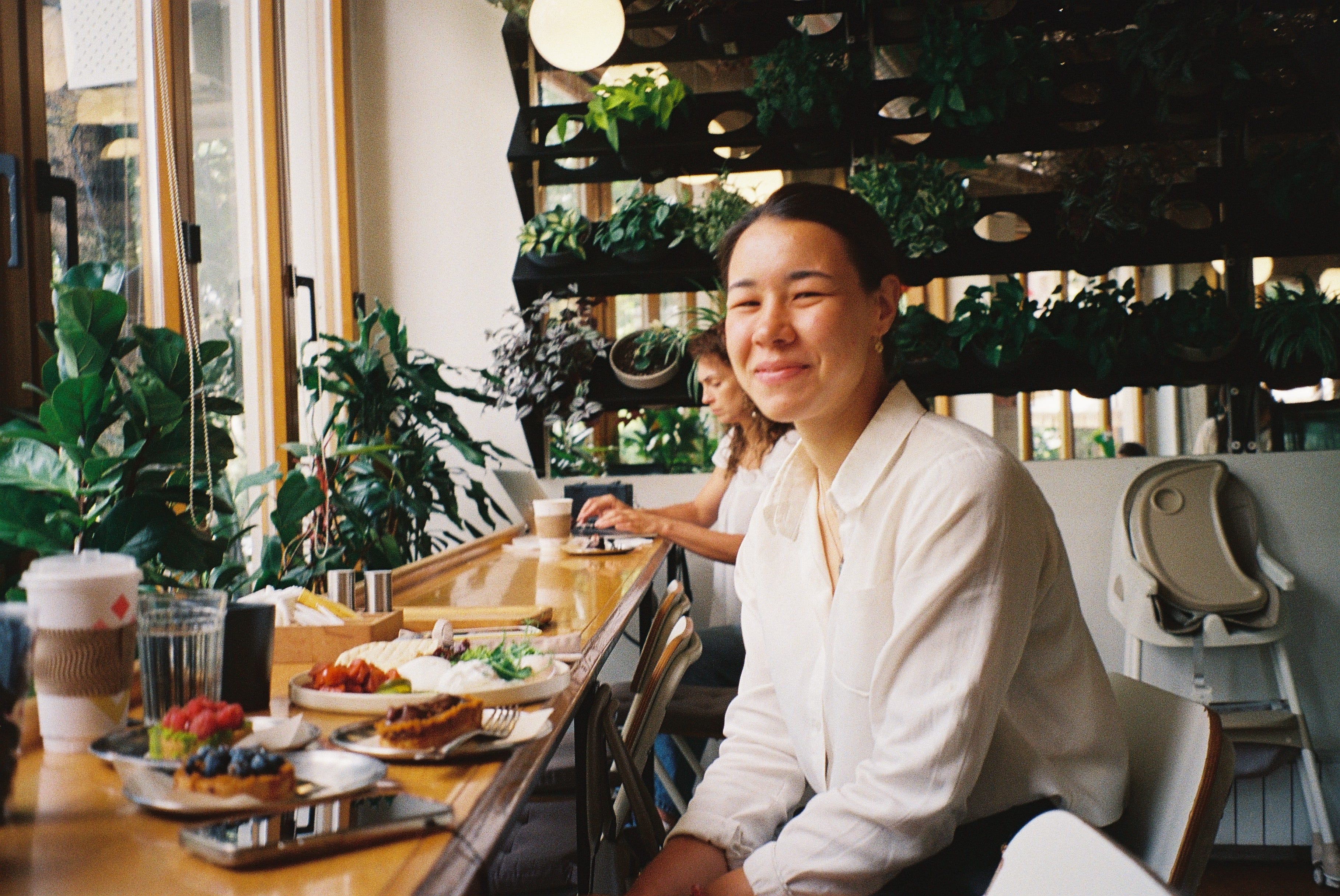
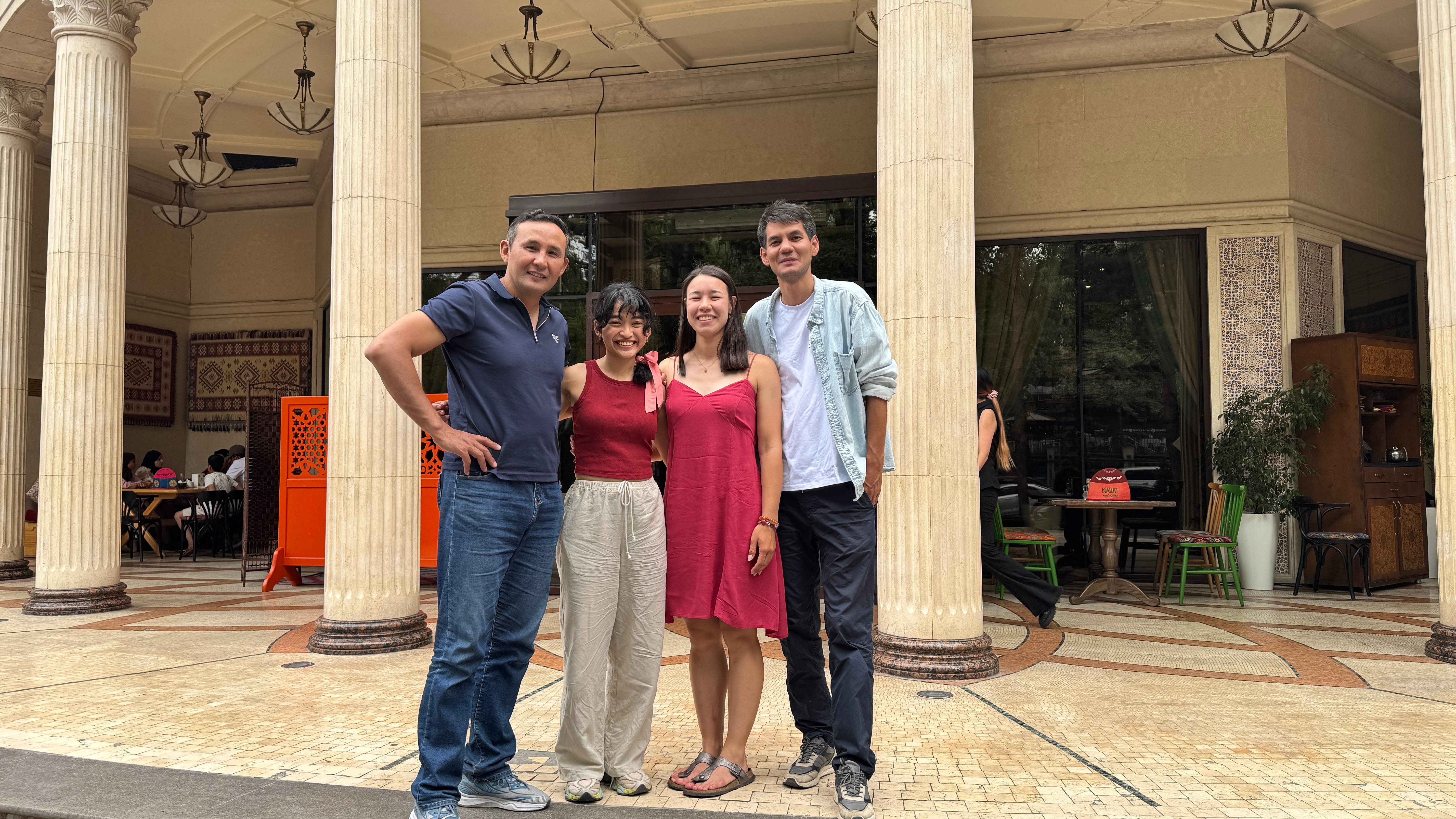
I met Sarra, Omir, and Temir again. The people I had first known only as “the group” slowly became individuals, each with a life and history I would never have discovered during a brief encounter.
The restaurant that was not on my itinerary
The following day, I went to a Chinese restaurant.
After spending days surrounded by unfamiliar food, I missed something closer to what I normally ate at home. The restaurant was famous, butI had not marked it on any map.
It was simply somewhere I decided to eat.
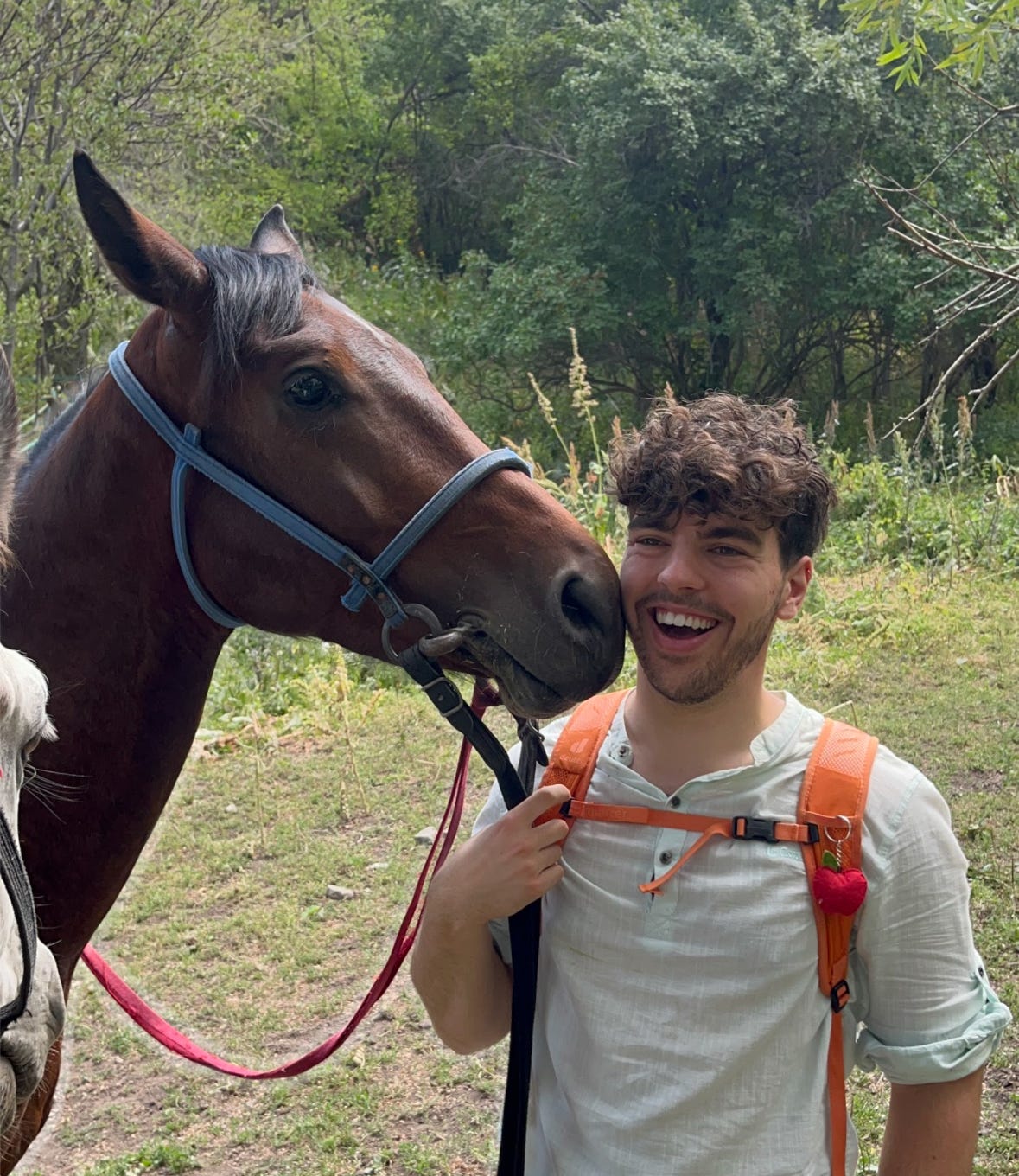
There, I met Vlad.
He was Romanian and had travelled to more than forty countries. At first, he was simply another stranger I happened to meet far from both of our homes.
Over time, he became one of my dearest friends.
There is something almost unreasonable about friendship when viewed through the logic of an itinerary. You cannot schedule the moment when a stranger becomes important to you. You cannot reserve it in advance, assign it a location, or estimate how many hours it will require.
The meeting itself may happen in a few minutes.
The friendship does not.
Had I left Kazakhstan according to my original plan, Vlad might have remained a pleasant conversation in a Chinese restaurant. Instead, because I stayed, the encounter was given enough time to continue.
His extensive travels also complicated the lesson I was beginning to form. Travelling widely was not necessarily shallow. Vlad had seen far more countries than I had, yet he was capable of forming genuine connections wherever he went.
The problem was not the number of places.
It was whether we remained anywhere—physically or emotionally—long enough for an encounter to deepen.
Seeing a place through someone else
Then there was Maks, a mutual friend of Ruslan’s.
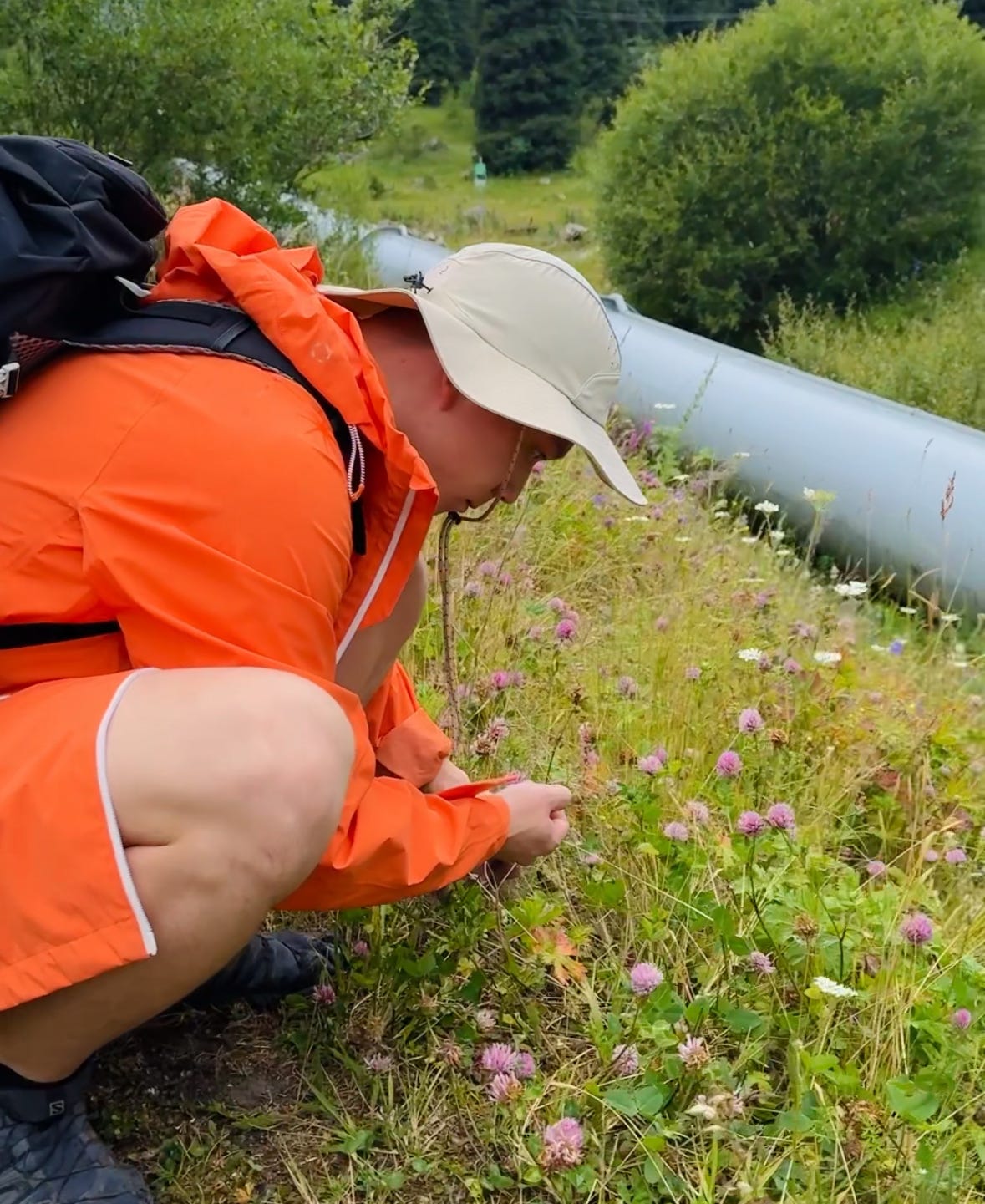
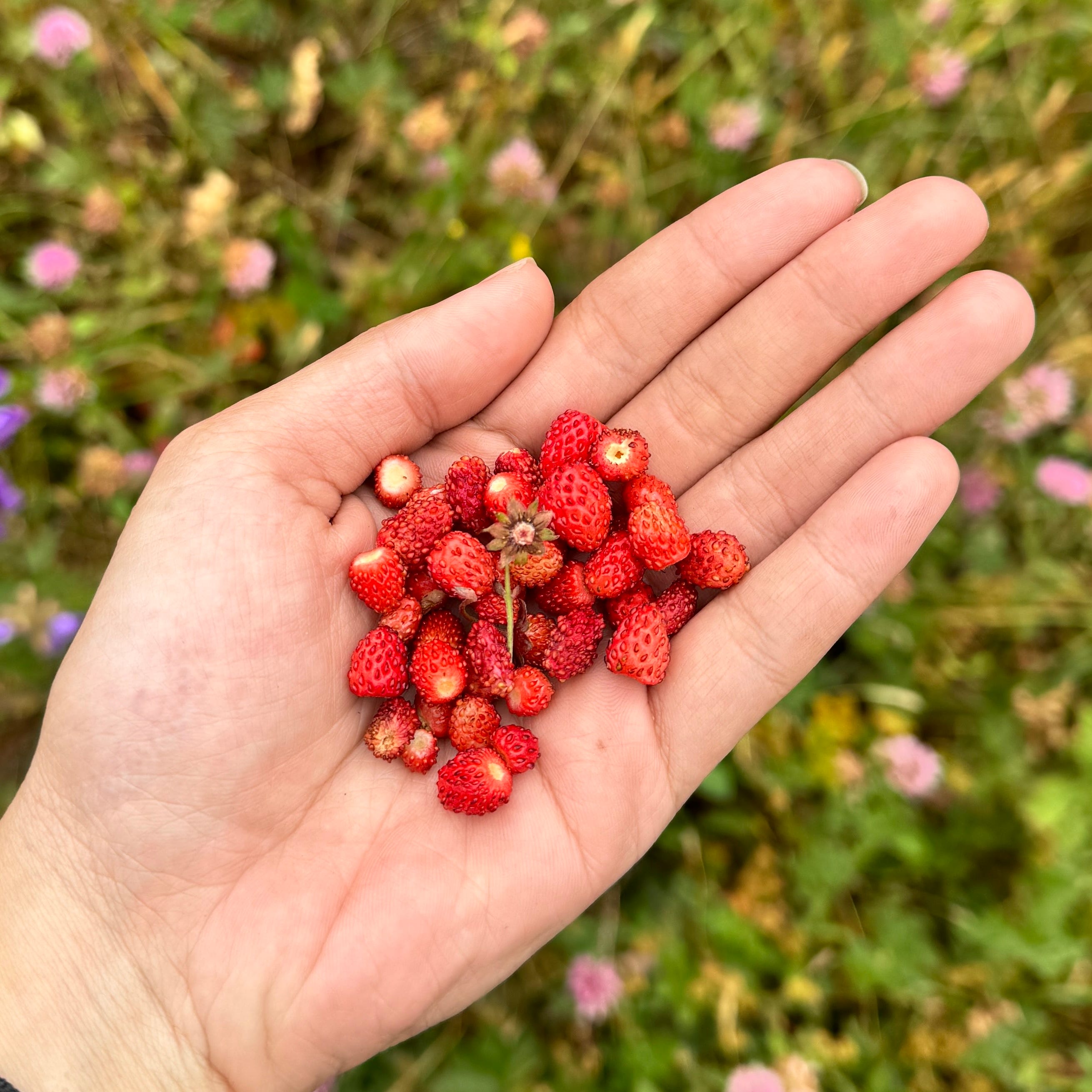
He introduced me to Big Almaty Lake and showed me the wild fruits growing along the trail. Later, on the way to Terra Glade, he introduced me to his sister and friends.
Terra Glade was one of the most beautiful valleys where I camped. But its beauty did not come from the landscape alone.
I was no longer passing through it as a solitary observer. I was walking with people who knew one another, noticed things I would have overlooked, and moved through the place with a familiarity I did not possess.
A photograph could preserve the shape of the valley. It could capture the light, the grass, and the mountains surrounding us.
But it could not fully preserve the feeling of being included.
The place became more beautiful because I was seeing community within it.
Ruslan welcomed me in another way. He invited me into the life of his family—with his wife and their baby, who has since grown into a very cool little child.
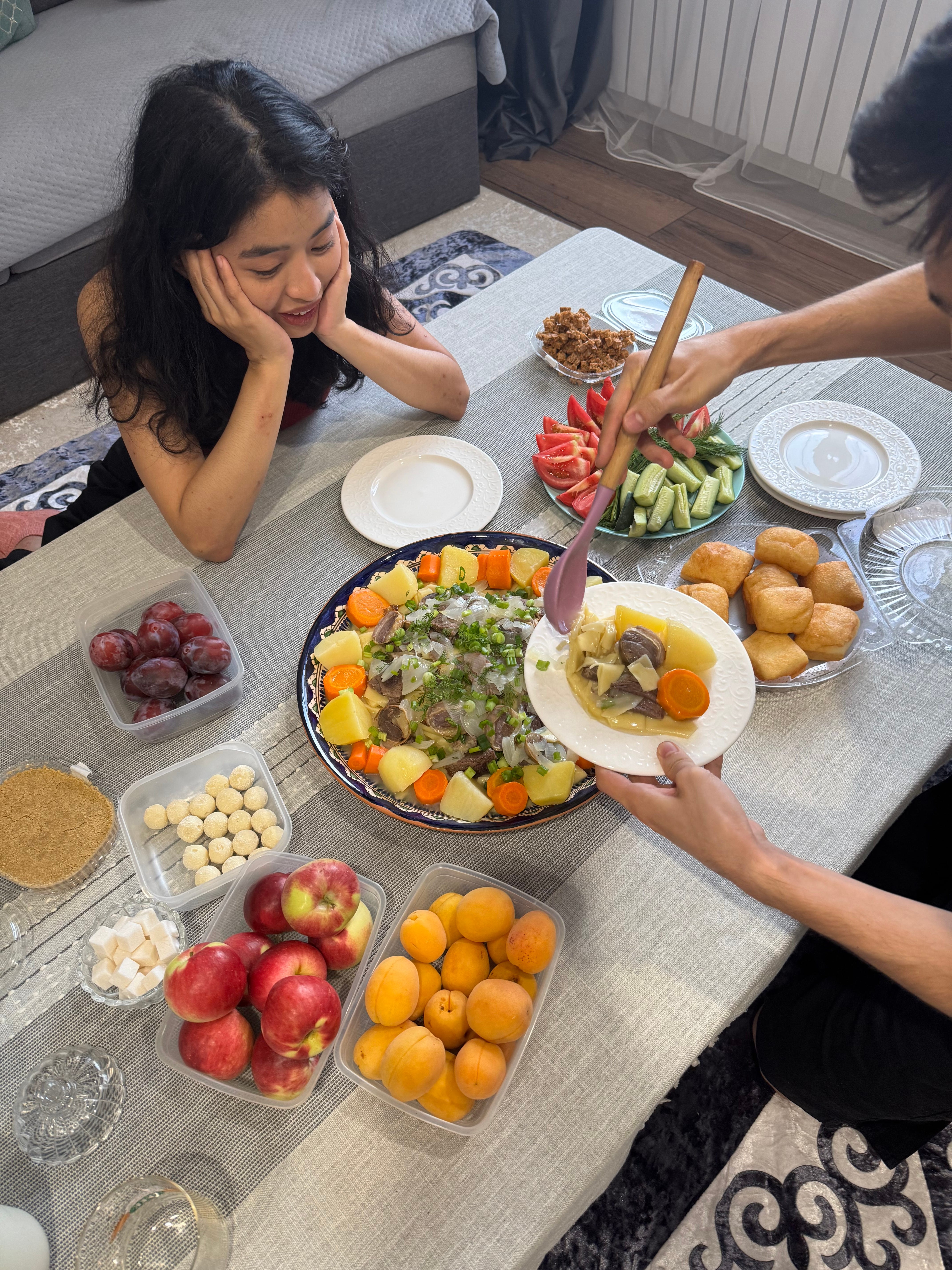
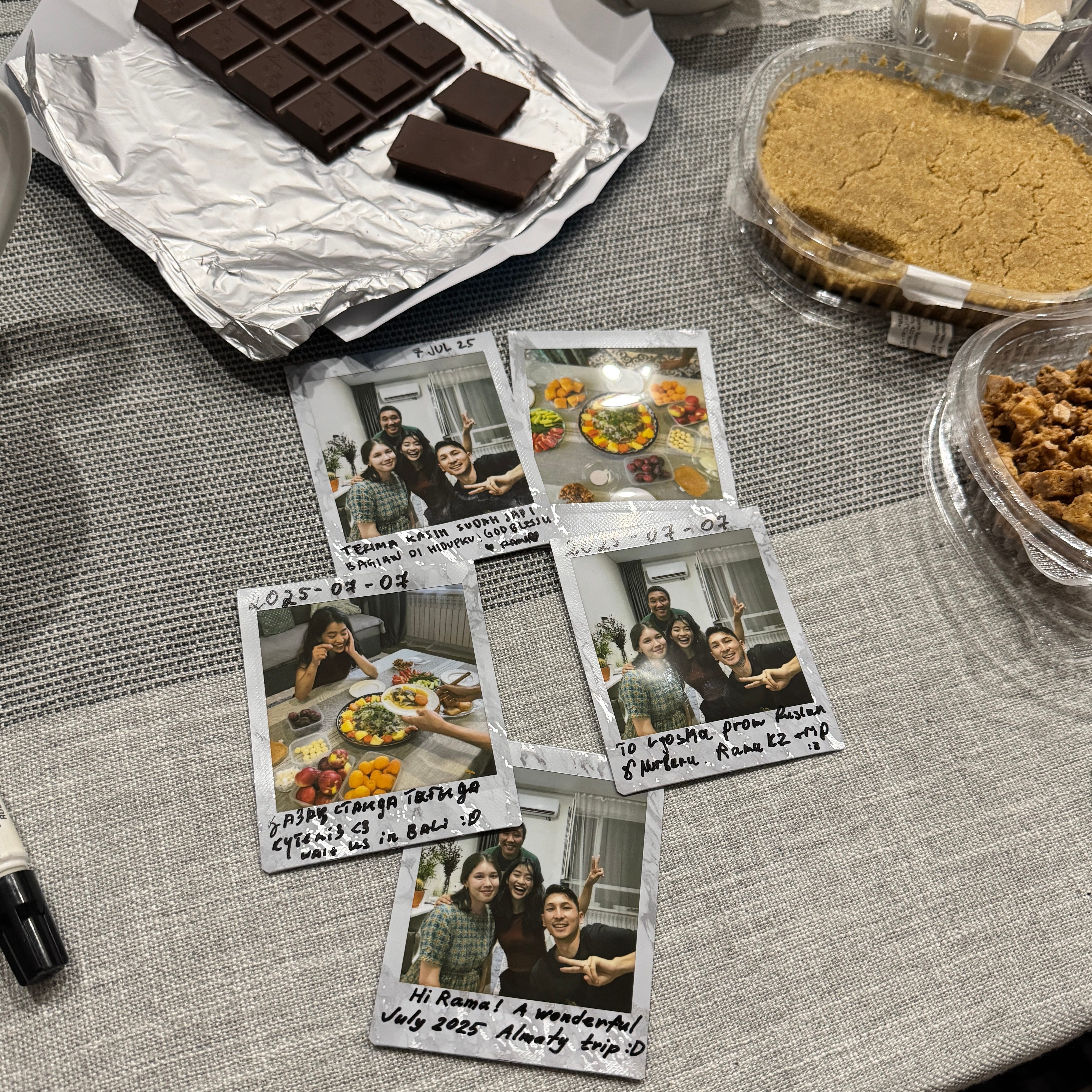
Even before these friendships developed, Kazakhstan had already begun introducing itself to me through strangers—including [the women I met by chance in a cable car]
Being welcomed into someone’s family home felt different from visiting another attraction.
By then, Kazakhstan was no longer a collection of mountains, lakes, and valleys.
It had become Sasha’s snail gesture. Sarra’s photography. Maks showing me fruit beside the trail. Vlad in a Chinese restaurant. Ruslan and his family welcoming me into their home.
The country had acquired faces.
What happens after “wow”?
The day after Titov adventure, I hiked another mountain: Bukreev Peak, this time with mutual friends of Ruslan.
The landscape was different. The route was different. The view was still beautiful.
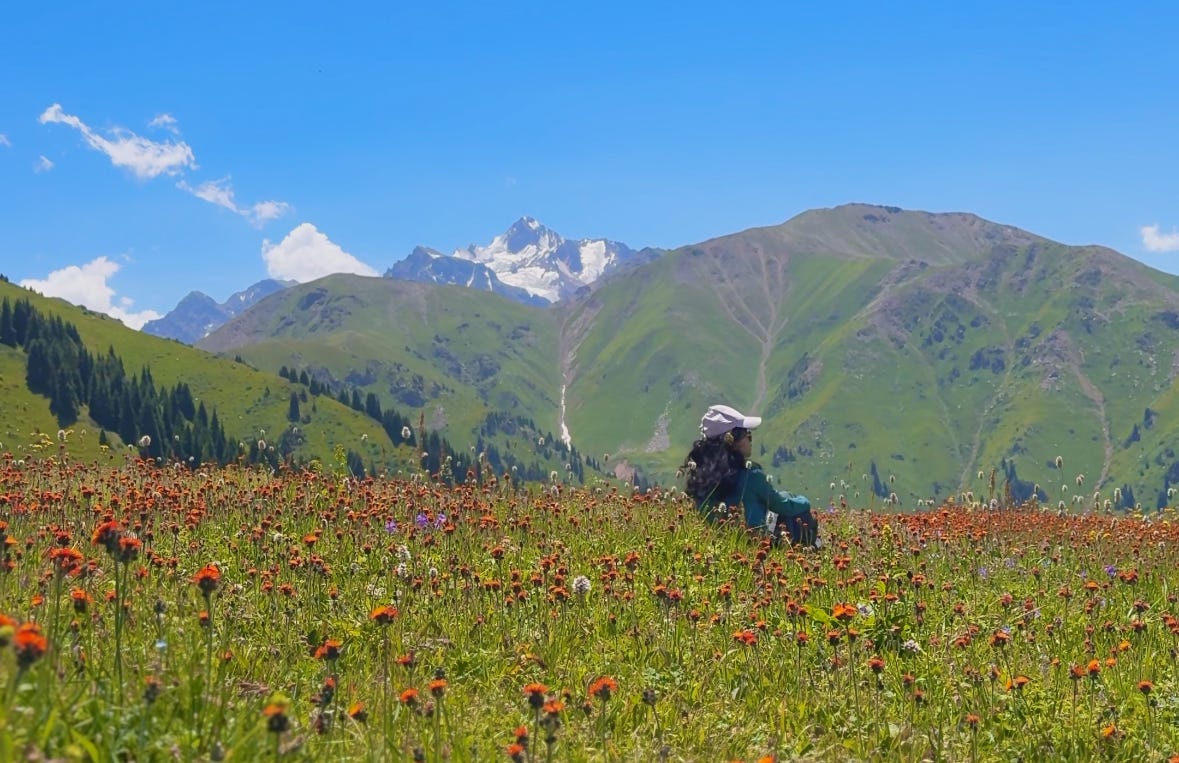
But it was still a mountain.
This does not mean that mountains are interchangeable, or that Kazakhstan looks like every other place. Each landscape has its own history, ecology, and character.
What I began to notice was that novelty follows a similar emotional pattern.
A new landscape can make us say, “Wow.”
A particularly extraordinary one may make us say, “WOW.”
But even astonishment eventually becomes familiar.
The mountain remains magnificent. We are simply no longer seeing it for the first time.
The people beside us, however, can become more complex the longer we know them.
A landscape may reveal itself immediately. A person rarely does.
Three or four days may be enough to see the architecture of a city, try its food, visit its famous landscapes, and form an impression of the people who live there.
But an impression is not the same as understanding.
Understanding often begins when the first impression stops being sufficient.
It may require meeting someone for a second time, when neither person is performing the politeness of an introduction. It may require hearing about their childhood, family, disappointments, ambitions, and the society that shaped them.
It may require enough time for our initial interpretation of them to be proven wrong.
When we leave quickly, we carry our first impressions with us.
When we stay, those impressions have a chance to fail.
The sentence I had already read
Two years before travelling to Kazakhstan, I had read Seneca’s Moral Letters to Lucilius, written almost two thousand years ago.
In Letter 2, he wrote:
“Everywhere means nowhere. When a person spends all his time in foreign travel, he ends by having many acquaintances, but no friends.”
At the time, the sentence did not affect me very much.
I understood it grammatically. I may even have agreed with it. But agreement is not always the same as understanding.
What makes the passage more interesting is that Seneca was not primarily writing about tourism. He was warning Lucilius against jumping constantly from one writer to another without remaining with any of them long enough to digest their ideas.
He compared hurried reading to hurried travel: visiting many authors without becoming intimately acquainted with any of them.
There was an irony I could not ignore.
Two years earlier, I had skimmed past Seneca’s warning against skimming.
When I opened the book again after Kazakhstan, the words felt different.
Seneca had not given me a new idea. Instead, he had given language to something the journey had already begun teaching me.
Some ideas enter our minds before our lives have created a place for them.
We can underline them. We can remember them. We can even repeat them to other people. But until experience gives them weight, they remain ideas that belong mostly to the writer.
The second time I encountered Seneca’s sentence, it belonged partly to me.
I had travelled towards a lake and returned with friendships. I had entered a restaurant looking for familiar food and met someone who became dear to me. I had gone towards valleys expecting scenery and discovered that the people around me determined what kind of experience the landscape became.
I was not discovering something new to the world.
I was arriving, through experience, at a truth that was ancient but still new to me.
When my body changed the itinerary
Eventually, my body began asking me to return home.
My mind could still see the countries left on the itinerary. It could calculate the remaining days and imagine the borders I might still cross.
But the body keeps a different kind of record.
It does not care how elegant the itinerary looks or how many destinations remain unchecked. It notices fatigue, discomfort, and the point at which continuing is no longer an act of curiosity but a refusal to listen.
So I went home.
I did not visit all five Central Asian countries. I did not complete the route I had announced to myself. There were cities I did not see, trains I did not board, and borders I did not cross.
Yet I do not think the journey failed.
My original itinerary had assumed that more movement would automatically produce more experience. Kazakhstan taught me that movement is only one kind of experience.
Staying creates another.
Different journeys, different knowledge
I do not think everyone must spend weeks in one country. A short trip can still be joyful, meaningful, and worthwhile. Time, money, health, and responsibility determine how people are able to travel.
Nor do I think travelling widely prevents genuine connection. Vlad, after all, had visited more than forty countries and still became one of my closest friends.
Different ways of travelling simply produce different kinds of knowledge.
Moving quickly can give us range. It introduces us to contrasts, landscapes, food, languages, and ways of living that we might never otherwise encounter.
Remaining gives us revision.
It gives an acquaintance time to become a friend. It allows someone to contradict our first interpretation of them. It lets a beautiful place become something more than scenery.
I still want to visit the rest of Central Asia.
But the next time I create an itinerary, I hope to treat it as a proposal rather than a contract. A journey does not necessarily become better each time another destination is added. Sometimes it becomes deeper when we stop adding destinations at all.
I went to Central Asia intending to count countries.
Instead, I began counting the conversations I would never have had if I had left on time.
My itinerary became smaller.
The journey did not.