

It was less than twenty-four hours after I arrived in Kazakhstan.
I had landed in Almaty the day before, and almost immediately found myself inside a supermarket, buying supplies. My body was still adjusting after the flight, but my mind had already moved to the mountains.
The next day, I wanted to go to Titov Lake.
I had seen it on YouTube. It looked quiet and beautiful, the kind of place that made me feel I had to see it with my own eyes. But there was very little information about how to get there. I could not find the lake clearly on the map, so I searched through whatever I could find. A few short videos, scattered comments, and fragments of routes from people who had gone before.
It was closer to a collection of clues than a guide.
Still, I knew one thing. I had to go to Medeu first.
From there, cable cars could take people higher into the mountains. So the next morning, I took a bus to the first entry point.
It was a busy Friday. Maybe it was summer vacation, because the place was full of people. Families, friends, couples, groups of visitors. They were looking at flowers, taking photos, sitting in cafés, and watching bees move from one flower to another.
But I noticed something.
Almost no one looked like they were preparing for a long walk.
No one seemed to be carrying a serious backpack. No one looked like they were planning to disappear into the mountains for hours, let alone stay there overnight.
That was the first problem.
I bought the cable car ticket anyway.
In my backpack, I had around eight kilograms of supplies. Food, three liters of water, hiking gear, an ultralight tarp tent, and two trekking poles.
When I entered the cable car, I had to share it with other passengers. The cabin could fit around eight people, and I ended up sitting with a group of women who looked to be in their sixties. They seemed like friends.
Then I became aware of myself through their eyes.
I must have looked strange there. Too much like a tourist, but maybe also not entirely like one. My face, perhaps, looked somewhat familiar to them and unfamiliar at the same time. Close enough to invite curiosity, different enough to raise questions.
One of the women said something rather loudly in Kazakh. I could not understand most of it, but I caught one word: “tourist.”
I think they were trying to figure me out.
For a moment, the air inside the cable car felt quiet in a specific way. It was the quietness of strangers sharing a small space, waiting to see who would speak first.
Then one of them turned to me and asked,
“You tourist?”
I smiled.
“Yes,” I said.
After I said yes, the questions began.
Where are you from? Where are you going? Are you alone?
Their English was limited, and my Kazakh and Russian were almost nonexistent. They spoke Kazakh and Russian so naturally with each other that I could only catch fragments (I did learn from Duolingo but in reality, it’s so hard to catch their phrase in real time). English might have existed as a foreign language subject for some students, but it was not the kind of language that lived around them every day.
Fortunately, before I came to Kazakhstan, a Kazakh friend had told me to download a translation app. It only had Russian translation, but it was enough.
So we talked through an app.
Slowly at first. Then with more confidence. Then with laughter.
They asked where I came from. I told them Indonesia. They seemed surprised that I had flown so far, almost twelve hours, and that I had come alone. To them, I think I looked very young. Maybe too young to be carrying a big backpack into the mountains by myself.
They asked where I was going.
I typed into the translator that I wanted to go to Titov Lake and stay overnight there.
They looked at each other. They did not seem to know the place.
Somehow, that made me smile. I understood it. Not everyone knows every beautiful place in their own country. Even in Indonesia, there are mountains, waterfalls, islands, and small villages that I have never heard of. Beauty can be very close to us and still remain unknown.
They kept saying I was brave.
Maybe they meant it as a compliment. Maybe they were also a little worried. But there was no judgment in their faces. Only curiosity, warmth, and a kind of fondness that appeared very quickly, as if they had decided within a few minutes that I should be taken care of.
They told me their names. One of them was Karligash. They told me where they came from, what they were doing there, and why they had come to the resort that day. I do not remember every detail now, but I remember the feeling clearly. The small cabin of the cable car, the mountains outside, the translation app between us, and the strange happiness of being understood without really sharing a language.
That was one of the most beautiful things.
We could laugh with very few words.
At one point, Karligash spoke into the translator. The phone translated it for me.
“You are beautiful.”
I laughed and typed back, “It is because your beauty is radiating to me.”
When the translation appeared, they read it together and suddenly burst into laughter. Not polite nor small laughter, but the kind that fills a room. The cable car, which had felt slightly awkward only minutes before, became warm. They hugged me. I laughed too, partly because the sentence was silly, partly because they understood the joke, and partly because I felt something open between us.
Before we arrived at the first checkpoint of the resort, they had already started giving me food. Apples. Kazakh snacks. Small things from their bags, offered so naturally that refusing felt almost impossible.
When we reached the station, they invited me to join them at a café. They wanted to sit, drink something, and enjoy the place.
But I was supposed to continue to the mountain.
In my head, I calculated the time. If I stayed too long, I might not reach the lake before dark.
But something in me paused.
I looked at them, and they looked so happy that I was there. I do not know how to explain it except that, in that moment, the plan felt less important than the invitation.
So I followed them.
We walked together around the resort. The wind was strong, and one of the women had difficulty walking, so I gave her one of my trekking poles. I helped them take photos. They posed together, laughing, holding each other’s arms. I had brought my own tripod, so we tried to take a picture with all of us in it.
But the wind was too strong.
The tripod fell.
We laughed again. In the end, we asked a stranger to take the photo for us.
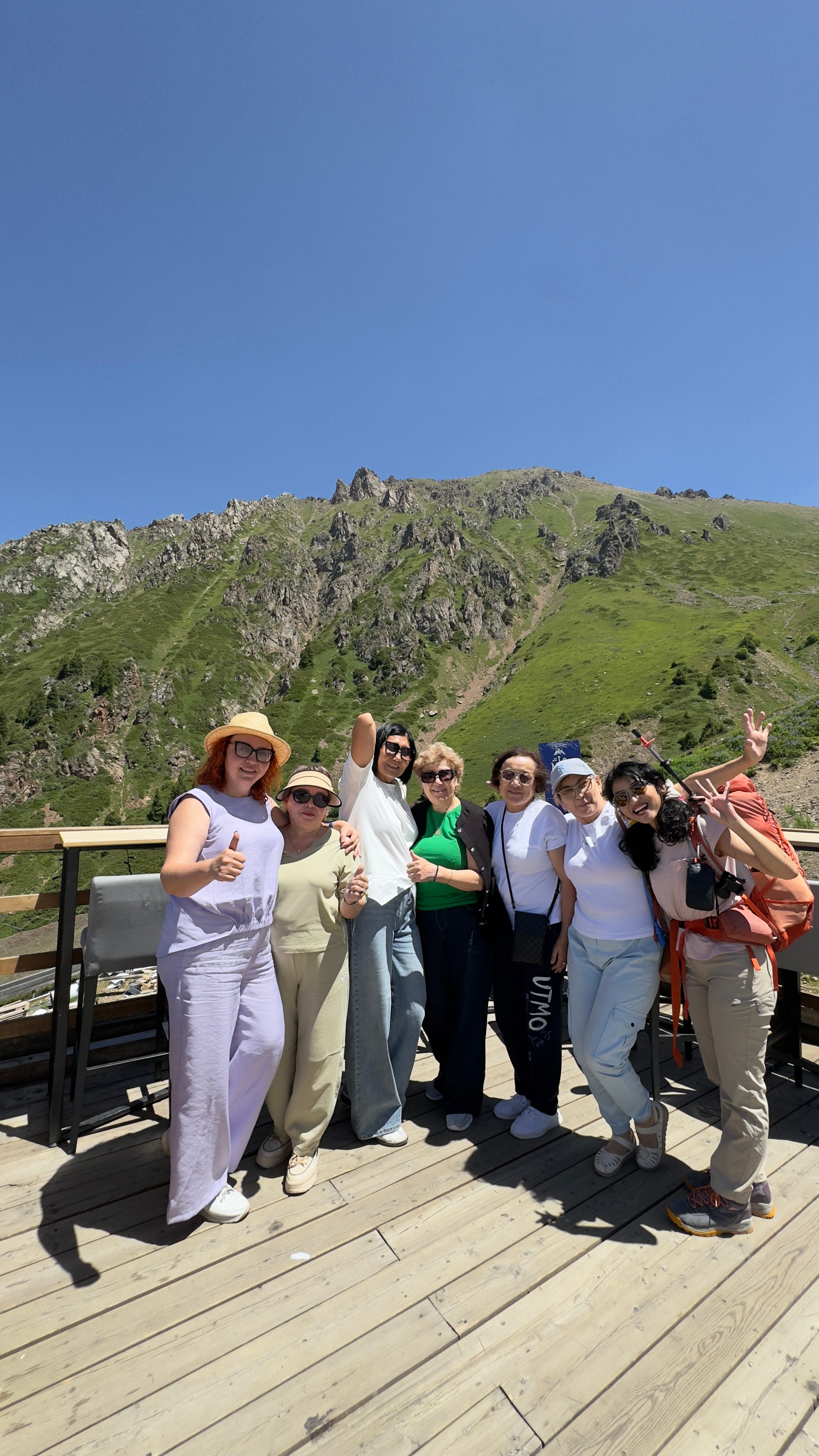
I spent some time with them without really noticing how much time had passed. Then I checked the clock and realized it was already noon.
I told them I had to go.
They understood. They asked where I would go after Almaty, and I told them I would stay in the city for a while before moving to Astana. One of them said she lived there. So we exchanged contacts, and they told me to let them know when I arrived.
Then I left them and continued toward Titov Lake.
A small fast-forward.
I did not know it yet inside the cable car, but this meeting was not going to end in the mountains. It would follow me to another city.
Astana
A few weeks later, I arrived in Astana.
But the story did not restart there. It had continued quietly after the day we met in Almaty.
After I returned from the mountain, Karligash had texted me to ask if I had come back safely. She also sent me a voice note. I did not understand what she said at first. I think it was in Russian, so I sent it to my friend and asked for help.
My friend told me that Karligash was wishing me well. She was happy to have met me, and she hoped everything would go smoothly for me.
It was such a simple message, but it stayed with me.
Later, she asked when I would come to Astana. I told her the date, though at that time it still felt like a plan in the future. Then, when the day finally came, she followed up again.
“Are you going today?”
I told her yes. I was really going that day.
At first, visiting her was not part of my plan. I had already booked an Airbnb in Astana, close to my company’s branch office, because I needed to work the next day. Karligash lived in the northern part of the city, almost an hour away from where I was supposed to stay.
Still, I thought, why not?
So I took a taxi to her place.
When I arrived, she was already waiting for me in front of the gate. The apartment area was dense and busy, with many buildings standing close to each other. I remember stepping out of the car with my bags, still a little unsure whether I was arriving as a guest, a stranger, or something in between.
But she greeted me as if I had always been expected.
She helped me with my things, and together we walked into the apartment complex. Then we went up to her home.
The apartment was busy when I entered.
There was a table full of food. Beshbarmak, the signature dish, sat at the center, surrounded by many small plates and condiments. Everything looked warm, generous, and carefully prepared.
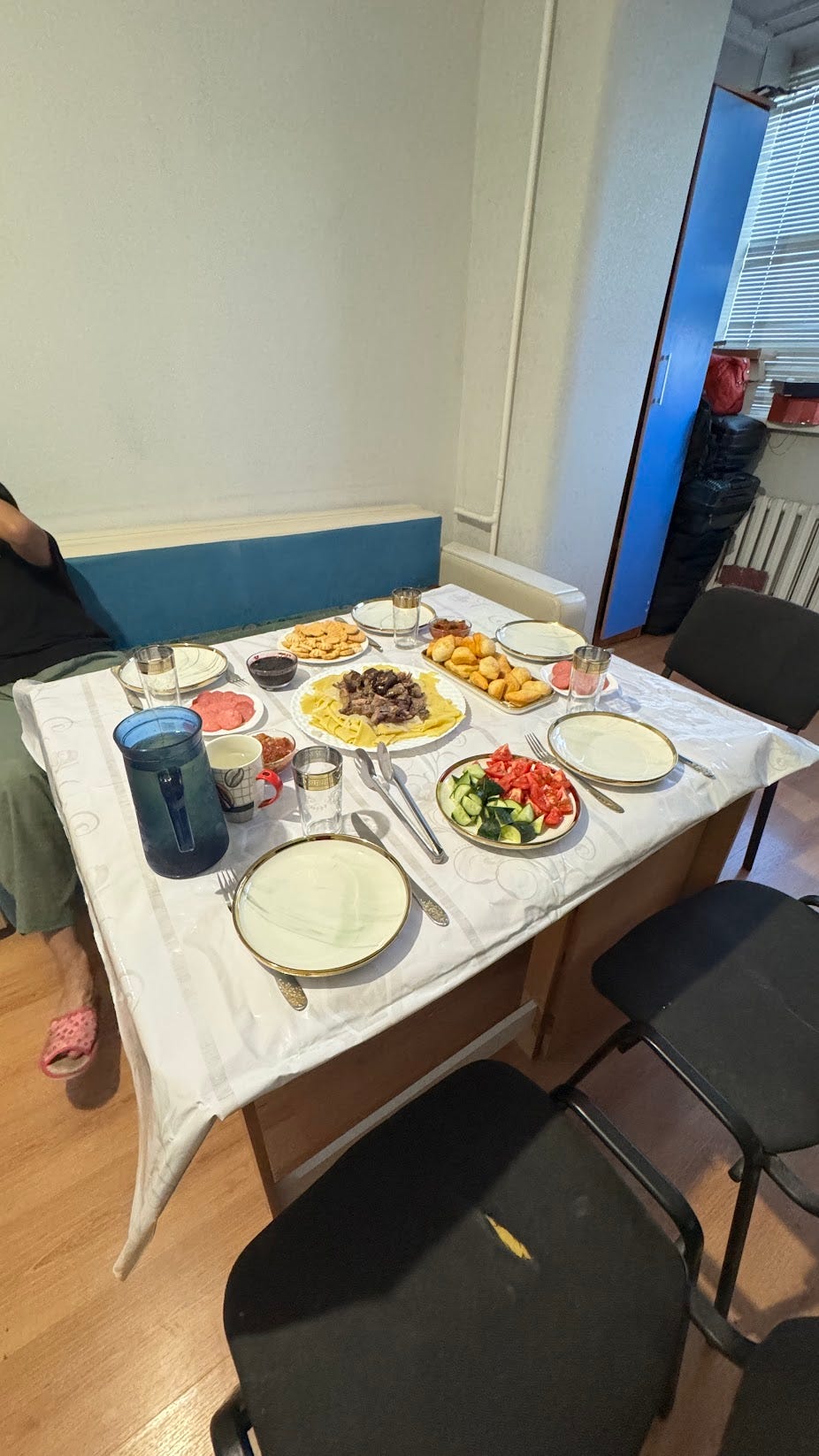
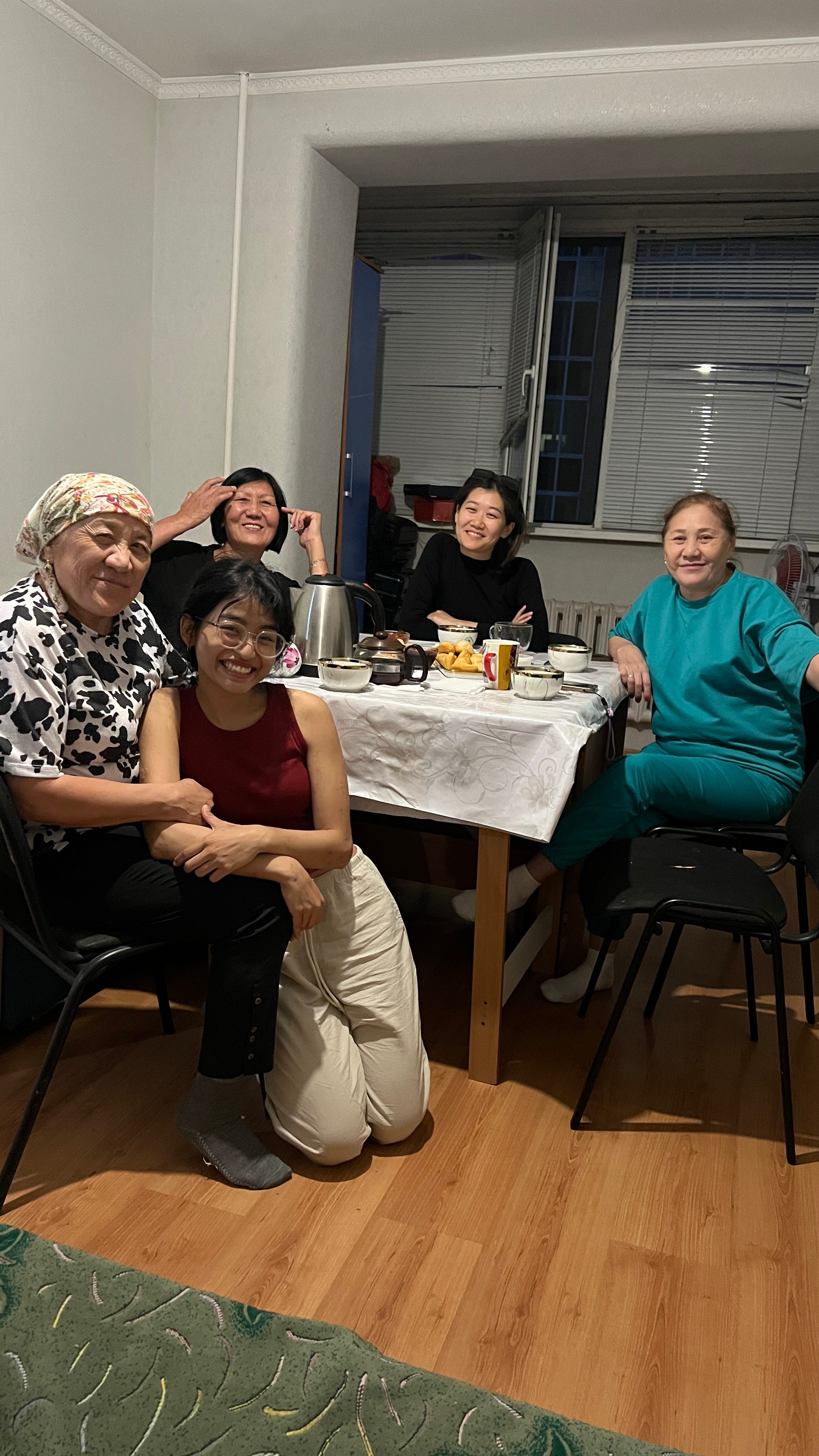
I was happy, of course. But I was also afraid.
I have a small stomach. I do not eat a lot, and suddenly I became nervous that I would disappoint them. There is a strange pressure when someone welcomes you with food. You want to receive it properly. You want to show gratitude, but your stomach has its own limits.
The language barrier was still there, but at home, the signal was better. The translation app worked more smoothly. Not long after, one of Karligash’s nieces came in. She was almost my age, and she spoke good English.
Suddenly, the room became easier.
We did not have to pass every sentence through the phone. We could ask, answer, laugh, and explain things with less waiting in between. They asked about my family, my background, my work, where I came from, and how long I would stay in Kazakhstan.
Then, somewhere in the middle of that conversation, I learned that Karligash was almost the same age as my father.
My father had passed away.
I did not expect that sentence to affect me so much. It was not new information. It was not something I usually cried about in front of people. But sitting there, in a stranger’s apartment in Astana, surrounded by food and women who had welcomed me as if I were already familiar, something inside me softened too quickly.
For a moment, I became quiet.
Then I cried.
Karligash came closer. She did not need a perfect translation to understand. Maybe grief has its own body language. Maybe missing someone is something people can recognize without explanation.
I tried to tell them that it had been a long time since I had been welcomed like that.
I did not know how to say it properly, even with translation. It was not only the food. It was not only the fact that Karligash had checked whether I returned safely from the mountain. It was the feeling of being expected in a place where I was supposed to be a stranger.
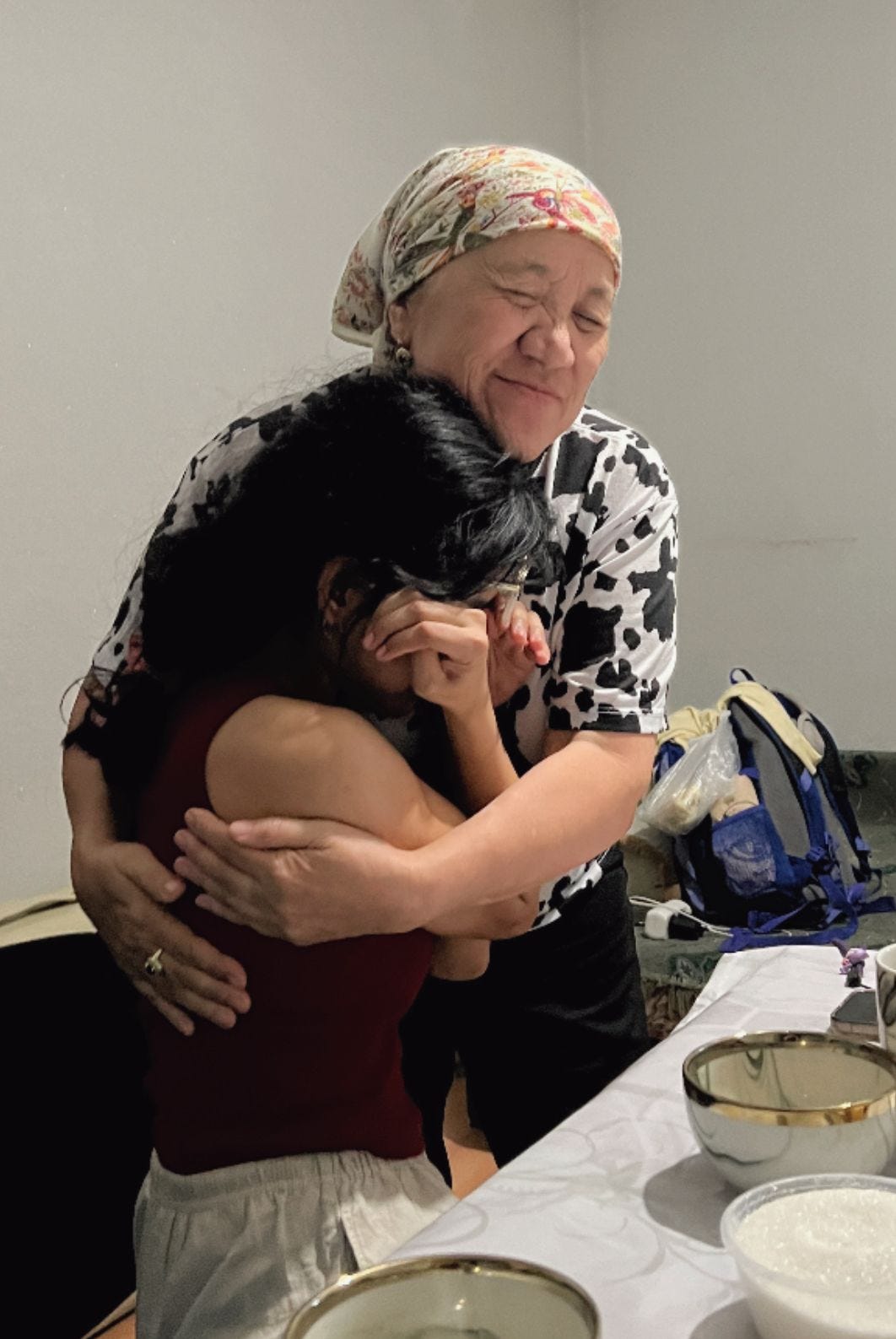
I had come to Kazakhstan thinking mostly about mountains, routes, and places I wanted to see. I did not expect to sit in someone’s apartment in Astana, eating beside people I had met by chance in a cable car, trying to explain my family through another person’s translation.
I kept thinking, do I deserve this?
No one in the room made me feel that I did not. The question came from somewhere else. Maybe from the strangeness of receiving something I did not earn. Maybe from the shock of being cared for in a place where I expected only to pass through.
What were the odds of meeting them in that cable car?
Sometimes life feels random until kindness gives it shape.
I thought travel was mostly about movement. A lake, a mountain, a city, a route on a map. But maybe travel is also this: a stranger interrupts your plan, and suddenly the place is no longer only a place.
In that room, I was not only a tourist anymore.
I was a guest.
And for a few hours, in a city far from home, I was received.